Deep Learning Powered Wearable Healthcare Systems for Continuous Patient Monitoring
Download PDFAbstract
The proliferation of wearable sensors and the advancements in deep learning have paved the way for a new era of proactive and personalized healthcare. This chapter explores the transformative potential of deep learning-powered wearable healthcare systems for continuous patient monitoring. We delve into the architecture of these systems, from data acquisition using wearable sensors to the application of sophisticated deep learning models for real-time health status assessment. The chapter provides a comprehensive overview of the state-of-the-art, including a review of various deep learning techniques such as Convolutional Neural Networks (CNNs), Recurrent Neural Networks (RNNs), and hybrid models, which are employed for analyzing physiological signals like electrocardiogram (ECG), photoplethysmography (PPG), and motion data. We discuss the complete workflow, encompassing data preprocessing, feature extraction, model training, and validation. Furthermore, we present a case study on a deep learning model for early detection of patient deterioration, showcasing the practical implementation and effectiveness of these systems. The chapter also addresses the challenges and future directions in this rapidly evolving field, including issues related to data privacy, model interpretability, and the need for large-scale, diverse datasets. Our aim is to provide a thorough understanding of how deep learning and wearable technology are converging to revolutionize patient care, enabling a shift from reactive to preventive medicine.
References
- Farida Sabry et al. “Machine learning for healthcare wearable devices: the big picture”. In: Journal of Healthcare Engineering 2022.1 (2022), p. 4653923.
- Fahad Khan et al. “ECG classification using 1-D convolutional deep residual neural network”. In: Plos one 18.4 (2023), e0284791.
- Michael R Scheid et al. “Development and validation of a clinical wearable deep learning based continuous in hospital deterioration prediction model”. In: Nature Communications 16.1 (2025), p. 9513.
- Arjun Mahajan, Kimia Heydari, and Dylan Powell. “Wearable AI to enhance patient safety and clinical decision-making”. In: npj Digital Medicine 8.1 (2025), p. 176.
- S Shajari et al. “The emergence of AI-based wearable sensors for digital health”. In: Sensors 23.17 (2024), p. 7589.
- Haneen A Elyamani et al. “Deep residual 2D convolutional neural network for cardiovascular disease classification”. In: Scientific Reports 14.1 (2024), p. 22040.
- C Kishor Kumar Reddy et al. “Detecting anomalies in smart wearables for hypertension: a deep learning mechanism”. In: Frontiers in Public Health 12 (2025), p. 1426168.
- Mohd Anjum et al. “Enhancing wearable sensor data analysis for patient health monitoring using allied data disparity technique and multi-instance ensemble perceptron learning”. In: Scientific Reports 15.1 (2025), p. 29555.
- Ali Abedi et al. “AI-driven real-time monitoring of cardiovascular conditions with wearable devices: scoping review”. In: JMIR mHealth and uHealth 13.1 (2025), e73846.
- Yann LeCun, Yoshua Bengio, and Geoffrey Hinton. “Deep learning”. In: nature 521.7553 (2015), pp. 436–444.
- Jeff Heaton. “Ian goodfellow, yoshua bengio, and aaron courville: Deep learning: The mit press, 2016, 800 pp, isbn: 0262035618”. In: Genetic programming and evolvable machines 19.1 (2018), pp. 305–307.
- S Hochreiter and J Schmidhuber. Long short-term memory. Neural Cornputation 9 (8): 1735–1780. 1997.
- Alex Krizhevsky, Ilya Sutskever, and Geoffrey E Hinton. “Imagenet classification with deep convolutional neural networks”. In: Advances in neural information processing systems 25 (2012).
- Diederik P Kingma and Jimmy Ba. “Adam: A method for stochastic optimization”. In: arXiv preprint arXiv:1412.6980 (2014).
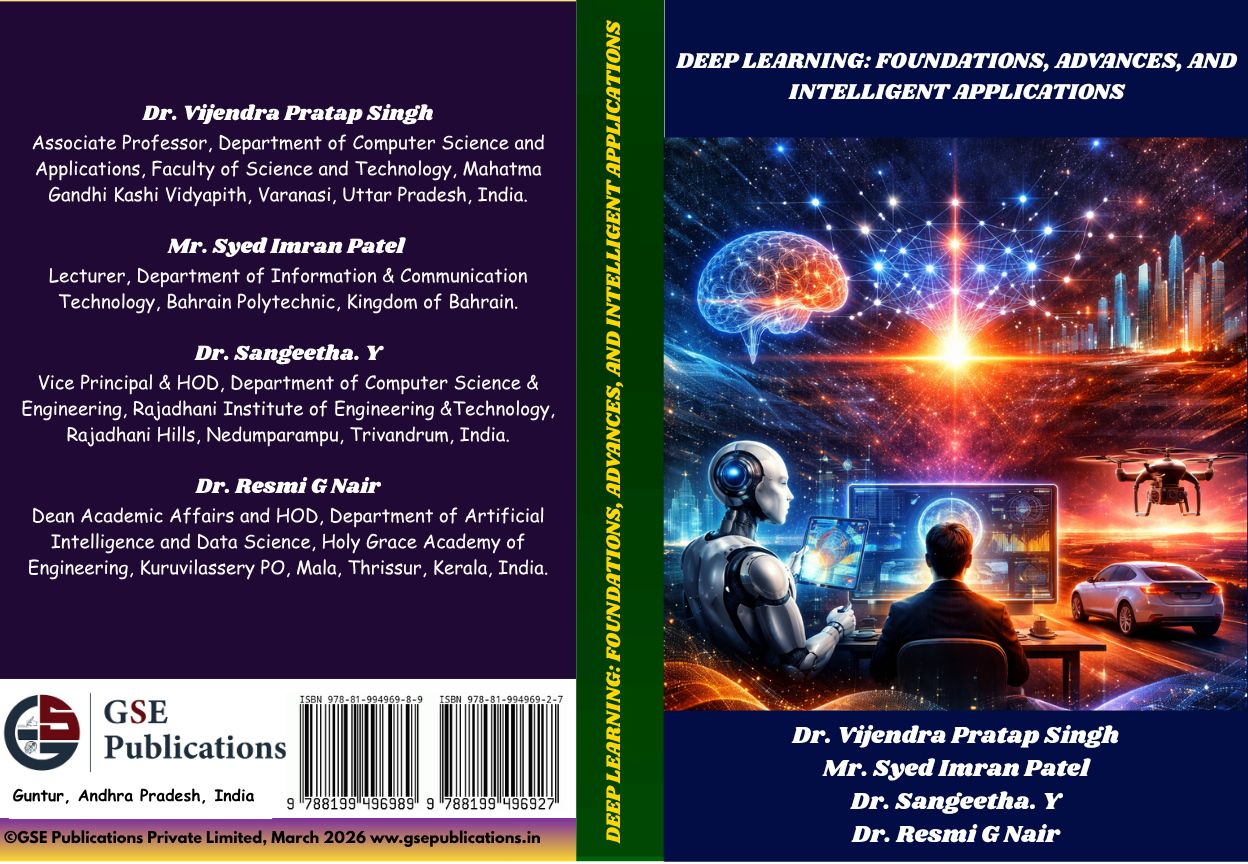 Deep Learning: Foundations, Advances, and Intelligent Applications
