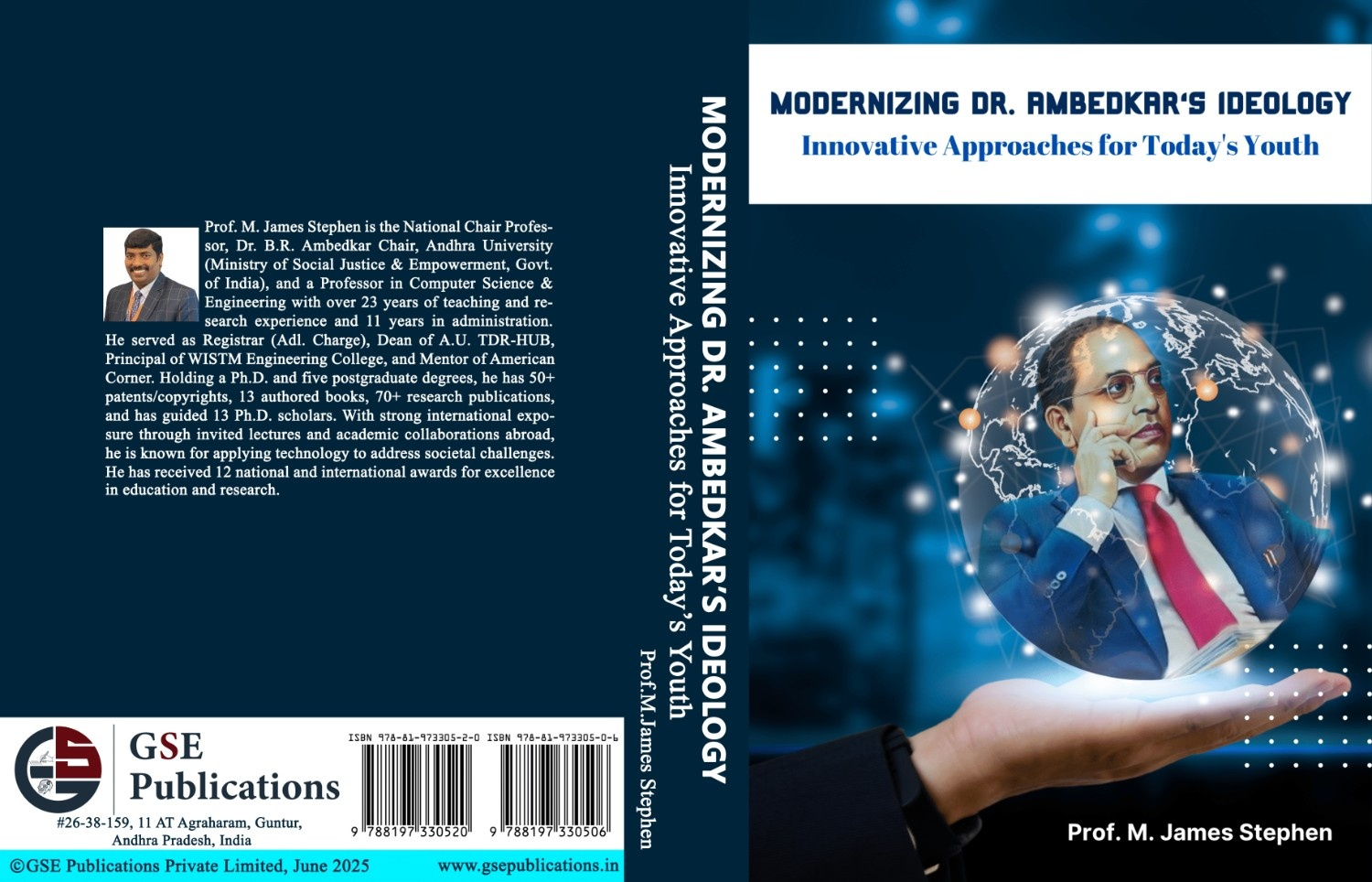
Modernising Dr. Ambedkar’s Ideology
The motivation behind writing “Modernising Dr. Ambedkar’s Ideology” stems from a striking moment on the popular Telugu TV show “Everu Meelo Koteswarudu”, hosted by renowned actor Akkineni Nagarjuna. During the show, a simple yet significant question was posed:” Who among the following is popularly known as Babasaheb?”. The options were A) Vallabhbhai Patel, B) Dr. B.R. Ambedkar, C) Rajendra Prasad, and D) Subhas Chandra Bose. A young contestant, playing to win a large prize, hesitated when faced with this question. Instead of identifying the correct answer-Dr. B.R. Ambedkar-she dismissed Ambedkar as a possibility and sought help through two lifelines. Unfortunately, even the audience poll steered her in the wrong direction, with the majority voting for Vallabhbhai Patel. After using the 50-50 lifeline, narrowing the options to Ambedkar and Patel, she still chose the incorrect answer, highlighting a troubling disconnect between today’s generation and Ambedkar’s legacy. This incident clearly reveals that many young people are unaware of the profound contributions of Dr. B.R. Ambedkar, not only as the chief architect of India’s Constitution but also as a visionary philosopher who championed modernization, urbanization, and industrialization. It underscores a growing gap between contemporary society, especially the Zee Generation, and the rich legacy of Ambedkar’s ideology, which is more relevant than ever in the modern world.
In response to this disconnect, the Dr. B.R. Ambedkar Chair at Andhra University, under the leadership of Prof. James Stephen Meka, took up the responsibility of reconnecting this generation with Ambedkar’s principles through a series of innovative events. These initiatives were designed to make students active participants, engaging them in ways that resonate with the digital age and contemporary sensibilities. Through interactive, creative, and inclusive formats, these events have proven successful in effectively communicating Ambedkar’s message to a modern audience. The central message remains unchanged-the advocacy for equality, social justice, and inclusion-but the methods of dissemination have been adapted to suit the evolving needs of society. By adopting modern approaches and leveraging student participation, these initiatives have bridged the gap between Ambedkar’s timeless ideology and the digital-savvy youth of today. It is the sincere hope of the author that this book, “Modernising Dr. Ambedkar’s Ideology”, will serve as a model for universities across India, encouraging them to implement similar initiatives to address the disconnect between today’s youth and Ambedkar’s enduring legacy. With a deeper understanding of his vision, this generation will be better equipped to carry forward the values of social justice, equality, and progress that Ambedkar envisioned for India.

References
- MSampathkumar. Social ideology of dr. br ambedkar–a study. Historical Research Letters, 17:43–46, 2015.
- Shraddha Nagar. A study on dr. br ambedkar’s vision on education and ideology and its relevance. 2023.
- N Jayaram. Education and emancipation: The saga and ideology of dr br ambedkar. In Education and Empowerment in India, pages 73–90. Routledge India, 2015.
- Bidyut Chakrabarty. Br ambedkar and the history of constitutionalizing india. Contemporary South Asia, 24(2):133–148, 2016.
- Eleanor Zelliot. Understanding dr. br ambedkar. Religion compass, 2(5):804–818, 2008.
- Bidyut Chakrabarty. The socio-political ideas of BR Ambedkar: liberal constitutionalism in a creative mould. Routledge, 2018.
- Kunal Debnath. Ambedkar’s ideas of nation-building in india. Studies in People’s History, 5(1):104–110, 2018.
- Mohan Singh Saggu. Br ambedkar’s vision on social justice in india. 2018.