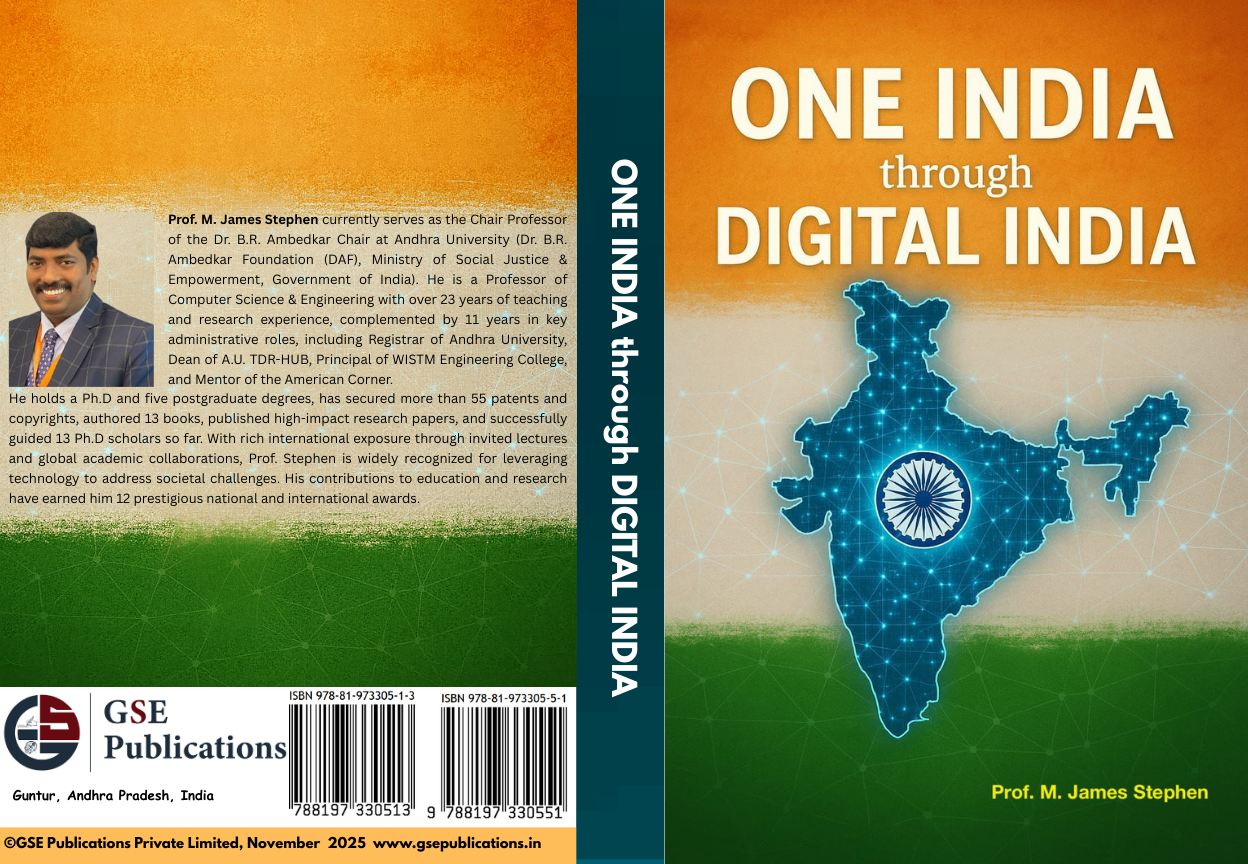
One India Through Digital India
The motivation behind writing “One India Through Digital India” arises from the belief that India’s unity, diversity, and democratic strength can be fully realized only when every citizen has equal access to the opportunities of the digital age. The Digital India initiative, launched in 2015, has laid the foundation for this transformation by bringing governance, education, healthcare, and financial services onto digital platforms. While these initiatives have revolutionized life in urban centers, large sections of rural and marginalized communities still struggle with barriers such as poor connectivity, affordability of devices, and lack of digital literacy. This imbalance reveals that the idea of “One India” remains incomplete without bridging the digital divide. Ensuring that every citizen—irrespective of region, caste, gender, or economic background-can participate in and benefit from the digital revolution is therefore central to achieving inclusive national progress.
In this endeavor, the Dr. B. R. Ambedkar Chair at Andhra University has been at the forefront of aligning Ambedkar’s timeless principles of equality, social justice, and empowerment with the opportunities offered by digital governance. Through digital literacy field visits, student engagement programs, and research-driven outreach, the Chair has demonstrated how Ambedkar’s vision can be modernized to resonate with today’s generation. This book builds on such initiatives, presenting a comprehensive exploration of how flagship schemes like Aadhaar, DigiLocker, UMANG, BharatNet, and PMGDISHA are shaping the future of governance and citizen participation. “One India Through Digital India” seeks to inspire policymakers, educators, and young citizens to view technology not merely as a tool of convenience, but as a force for national integration, inclusivity, and sustainable development-paving the way for a stronger, united, and digitally empowered India.

References
- Atul Pandey. Relevance of ambedkar’s vision on social inclusion in contemporary time. Available at SSRN 5007383, 2021.
- Praveen B Choppala and James S Meka. The digital india initiative: a realisation of babasaheb’s and mahatma’s vision. Digital Society, 3(2):38, 2024.
- FHI 360. India digital financial inclusion: Journey map report. Technical report, FHI 360, 2018.
- Jorge Juliao, Tonny Ayllon, and Marcelo Gaspar. Financial inclusion through digital banking: The case of peru. In International Conference Innovation in Engineering, pages 294–304. Springer, 2022.
- Alan Gelb, Anit Mukherjee, and Kyle Navis. Digital governance in developing countries: beneficiary experience and perceptions of system reform in rajasthan, india. Center for Global Development Working Paper, (489), 2018.
- OpenGov Asia. India’s efforts to enhance rural digital connectivity and literacy, April 2025.
- CBWE. Digital literacy, n.d. Accessed: 2025-09-07.
- Press Information Bureau. Scheme for digital empowerment of women, 2022.
- The Print. How can women lead india’s growth story? first close the digital gender divide, May 2024.
- Vikaspedia. Mahila e-haat, n.d. Accessed: 2025-09-07.
- A Gurumurthy and N Chami. Digital india through a gender lens: It for change, 2020.
- Smita Pande, Arti Chandani, and Smita Wagholikar. Digital governance across whole-of-the-government: Opportunities and challenges. Financial Internet Quarterly, 21(1):67– 75, 2025.
- Medianama. Views: India’s hasty ai push in governance may widen social divides, February 2025.
- VEDA. Digital-library app: Revolutionizing education with ai tools, ebooks [video]. YouTube, 2024. Accessed: 2025-09-07.
- India eLibrary. An ebooks platform with updated content [video]. YouTube, 2024. Accessed: 2025-09-07.
- Reuters. India file: Digital cash is everywhere, and so are scammers, March 2025.
- Financial Times. India wants to offer a third way for global tech, December 2024.
- CBWE. Digital literacy, n.d. Accessed: 2025-09-07.
- Praveen B Choppala and James S Meka. The digital india initiative: a realisation of babasaheb’s and mahatma’s vision. Digital Society, 3(2):38, 2024.
- Alan Gelb, Anit Mukherjee, and Kyle Navis. Digital governance in developing countries: beneficiary experience and perceptions of system reform in rajasthan, india. Center for Global Development Working Paper, (489), 2018.
- ISCI Foundation. Mapping sustainable development goals with india’s government initiatives, 2024.
- Ministry of Electronics and IT. Sdg vision for digital india. Technical report, Local2030, 2018.
- Asia IP Law. Role of innovation and ipr in self-reliant model of economic development, 2023.
- India Brand Equity Foundation. Intellectual property rights (ipr) in india: An overview, 2022.
- Dhananjay Keer. Dr. Babasaheb Ambedkar: Life and Mission. Popular Prakashan, 2015.
- Praveen B Choppala and James S Meka. The digital india initiative: a realisation of babasaheb’s and mahatma’s vision. Digital Society, 3(2):38, 2024.
- Atul Pandey. Relevance of ambedkar’s vision on social inclusion in contemporary time. Available at SSRN 5007383, 2021.
- Alan Gelb, Anit Mukherjee, and Kyle Navis. Digital governance in developing countries: beneficiary experience and perceptions of system reform in rajasthan, india. Center for Global Development Working Paper, (489), 2018.
- Smita Pande, Arti Chandani, and Smita Wagholikar. Digital governance across whole-of-the-government: Opportunities and challenges. Financial Internet Quarterly, 21(1):67– 75, 2025.
- Pradhan Mantri Gramin Digital Saksharta Abhiyan (PMGDISHA). Official dashboard, n.d. Accessed: 2025-09-07.
- V. Kumar. Digital content creation for learning: Strategies and tools. International Journal of Education and Development, 9(2):45–59, 2023.
- CBWE. Digital literacy modules, n.d. Accessed: 2025-09-07.
- A. Sinha. Effective online pedagogy in higher education. University News, 60(35):12–18, 2022
- M. Khan. Best practices in mooc and virtual learning content. EdTech Review Journal, 11(3):27–33, 2023.
- Ministry of Home Affairs, Govt. of India. National cybercrime reporting portal, 2021.
- CERT-In. Cyber security threats and preventive measures, 2023.
- S. Singh. Cyber etiquette and safe online practices for indian citizens. Journal of Cybersecurity Education, 5(1):66–75, 2023.
- UGC. Shodhganga - a reservoir of indian theses, n.d. Accessed: 2025-09-07.
- P. Sharma. Academic writing with microsoft word and latex. Research Skills Quarterly, 18(4):90–101, 2023.
- Digital Scholar. Canva for academicians: A design thinking approach, 2022.
- NPTEL. Introduction to latex, 2023.
- Digital India Portal. Basic and advanced computer training modules, n.d. Accessed: 2025-09-07.
- CBWE. Digital tools training curriculum, n.d. Accessed: 2025-09-07.
- J. Sandefur and A. Surie. Digital governance in developing countries: Beneficiary experience and perceptions of system reform in rajasthan, india. Technical report, Center for Global Development (CGD), 2022.
- CBWE. Field visit guidelines and case documentation for social empowerment, n.d. Accessed: 2025-09-07.
- Ministry of Electronics and IT, Government of India. Sdg vision for digital india. Technical report, Local2030, 2018.
- UNDP India. Digital public infrastructure and sdg acceleration, 2023.
- Asia IP Law. Role of innovation and ipr in self-reliant model of economic development, 2023.
- India Brand Equity Foundation. Intellectual property rights in india: Overview and opportunities, 2022.
- World Intellectual Property Organization (WIPO). Geographical indications and rural economic growth, 2022.