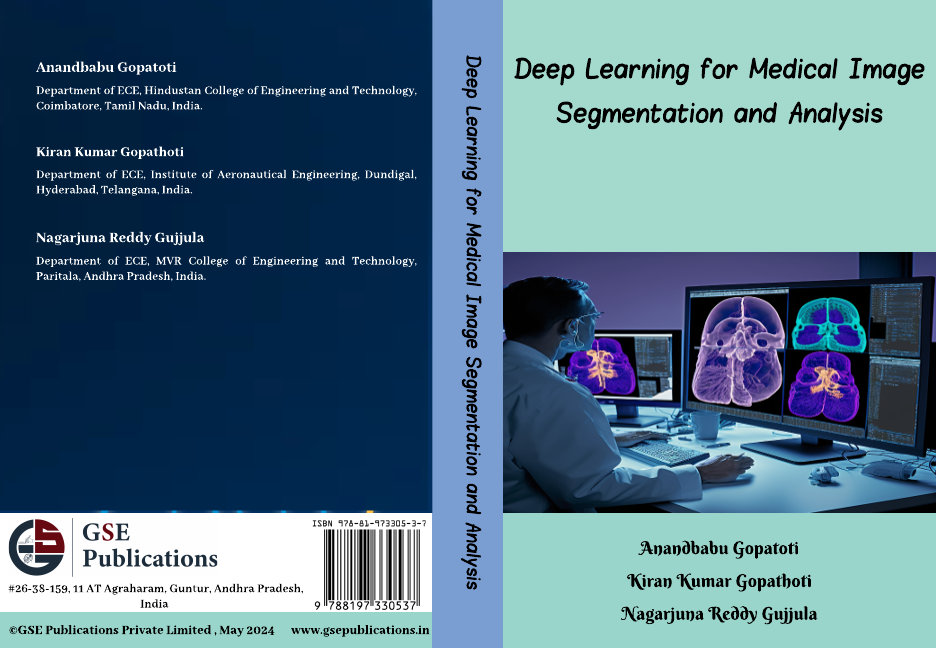
Deep Learning for Medical Image Segmentation and Analysis
Keywords:
Deep Learning, Medical Image, Segmentation, Convolutional Neural Networks, Recurrent Neural Networks, Explainable AISynopsis
Deep Learning for Medical Image Segmentation and Analysis is a comprehensive guide that delves into the intricate world of medical imaging, with a specific focus on the application of deep learning techniques. As the medical field continues to embrace digital transformation, the ability to accurately interpret and analyze medical images has become increasingly vital. This book serves as both an educational resource and a practical manual for those looking to understand and apply deep learning methods to this critical area of healthcare. The book is structured to cater to a broad audience, from students and novices in deep learning to seasoned researchers and practitioners in medical imaging. It begins with a solid foundation in the basics of deep learning, providing readers with the essential knowledge needed to grasp more advanced concepts. The initial chapters introduce key deep learning architectures, such as convolutional neural networks (CNNs), recurrent neural networks (RNNs), and transformers, with a particular emphasis on how these models can be adapted for medical image segmentation and analysis. As readers progress, they will encounter more complex topics, including advanced deep learning techniques, transfer learning, and model optimization strategies. The book also explores the challenges unique to medical imaging, such as dealing with imbalanced datasets, high-dimensional data, and the need for interpretability and transparency in models. Special attention is given to cutting-edge methods like 3D segmentation, attention mechanisms, and hybrid models that combine different deep learning approaches. Each chapter is complemented by practical examples and case studies drawn from real-world medical applications, including radiology, pathology, and oncology. These examples illustrate how deep learning is currently being used to improve diagnostic accuracy, enhance image quality, and streamline clinical workflows. The book also includes detailed discussions on the integration of deep learning models into clinical practice, addressing issues related to regulatory compliance, data privacy, and the ethical implications of AI in healthcare. In addition to technical content, the book considers the future of deep learning in medical imaging. It discusses emerging trends, such as the use of AI for personalized medicine, the potential of federated learning in healthcare, and the ongoing development of explainable AI models that can offer clinicians greater insight into the decision-making process of neural networks. Deep Learning for Medical Image Segmentation and Analysis is not just a textbook but a comprehensive resource designed to equip readers with the skills and knowledge necessary to navigate and contribute to this rapidly evolving field. Whether you are seeking to understand the basics of deep learning, explore the latest advancements in medical image analysis, or apply these techniques in a clinical setting, this book will provide you with the insights and tools you need to succeed.
References
1. Lai M. Deep learning for medical image segmentation. arXiv preprint arXiv:1505.02000. 2015 May 8.
2. Cao L, Li L, Zheng J, Fan X, Yin F, Shen H, Zhang J. Multi-task neural networks for joint hippocampus segmentation and clinical score regression. Multimedia Tools and Applications. 2018 Nov;77(22):29669-86.
3. Akkus Z, Galimzianova A, Hoogi A, Rubin DL, Erickson BJ. Deep learning for brain MRI segmentation: state of the art and future directions. Journal of digital imaging. 2017 Aug;30(4):449-59.
4.Thyreau B, Sato K, Fukuda H, Taki Y. Segmentation of the hippocampus by transferring algorithmic knowledge for large cohort processing. Medical image analysis. 2018 Jan 1;43:214-28.
5.Ataloglou D, Dimou A, Zarpalas D, Daras P. Fast and precise hippocampus segmentation through deep convolutional neural network ensembles and transfer learning. Neuroinformatics. 2019 Oct;17(4):563-82.
6. Suja GP, Kaleeswari P, Raajan P, Prasad AR, Aarthi K, Gopatoti A. 3D Brain Tumor Segmentation on U-Net Classifier. In2023 International Conference on Sustainable Computing and Data Communication Systems (ICSCDS) 2023 Mar 23 (pp. 592-597). IEEE.
7.Gopatoti A, Vijayalakshmi P. Design of optimised lung lobe segmentation and deep learning model for effective COVID-19 prediction. International Journal of Bio-Inspired Computation. 2023;22(1):16-27.
Published
15 May 2024
Series
Copyright (c) 2024 GSE Publications
License

This work is licensed under a Creative Commons Attribution-NonCommercial-NoDerivatives 4.0 International License.
Details about the available publication format: About Book
About Book
ISBN-13 (15)
978-81-973305-3-7
How to Cite
Gopatoti, A. ., Gopathoti, K. K. ., & Gujjula, N. R. . (2024). Deep Learning for Medical Image Segmentation and Analysis. GSE Publications . https://doi.org/10.58599/9788197330537.15052024