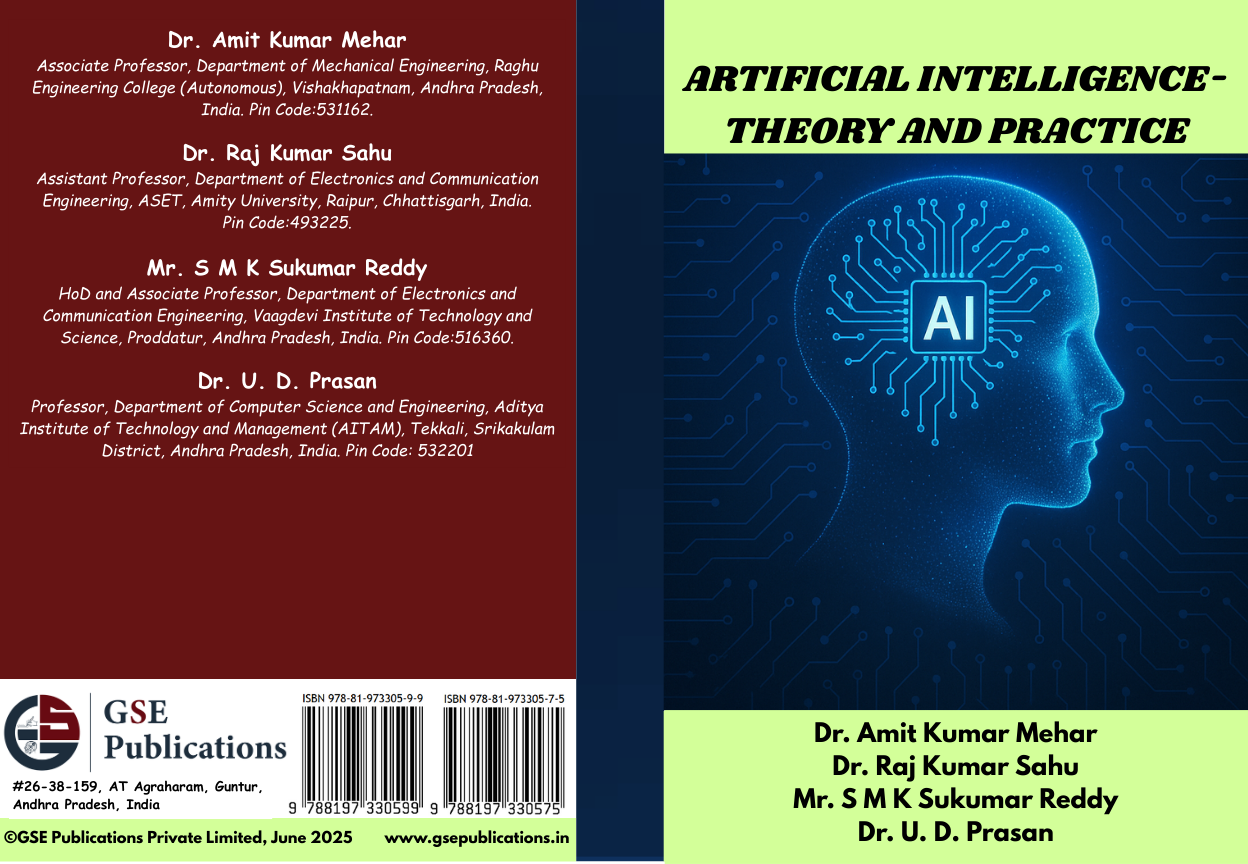
Artificial Intelligence-Theory and Practice
Keywords:
Artificial Intelligence, Machine Learning, Deep Learning, Knowledge Representation and Reasoning, Natural Language Processing, Computer VisionSynopsis
Artificial Intelligence-Theory and Practice offers a comprehensive journey
through the key areas of artificial intelligence, providing readers with both
foundational knowledge and insights into advanced topics. The book begins with an overview of AI as a discipline, exploring its definition, historical development, types of intelligence, and major milestones. It introduces core mathematical concepts essential to understanding AI systems, such as linear algebra, probability, statistics, calculus, and optimization techniques. These tools form the analytical basis for many AI methods and models. The book proceeds to discuss classical AI approaches to problem solving, including state-space search techniques and both uninformed and informed algorithms. It examines adversarial search strategies used in competitive environments and dives into knowledge representation and reasoning-focusing on logic-based systems, ontologies, and probabilistic reasoning methods that enable machines to draw conclusions and make decisions.
A significant portion of the book is devoted to machine learning. Readers
are introduced to key learning paradigms-supervised, unsupervised, and reinforcement learning-and the process of model selection and evaluation. It explains classical machine learning algorithms such as regression, decision trees, support vector machines, and clustering techniques. The book then explores deep learning, covering artificial neural networks, convolutional and recurrent architectures, autoencoders, generative adversarial networks (GANs), and transfer learning, all of which have enabled breakthroughs in modern AI applications. Specialized fields such as natural language processing and computer vision are explored in depth. Topics include tokenization, syntactic analysis, word embeddings, and powerful transformer models like BERT and GPT. The computer vision section discusses image analysis techniques, convolutional neural networks, and newer architectures like vision transformers.
References
1. Dean T, Allen J, Aloimonos Y. Artificial intelligence: theory and practice. Benjamin-Cummings Publishing Co., Inc.; 1995 Jan 5.
2. Kaplan J. Artificial intelligence: Think again. Communications of the ACM. 2016 Dec 20;60(1):36-8.
3. Barr A, Feigenbaum EA, Cohen PR, editors. The handbook of artificial intelligence. HeurisTech Press; 1981.
4. Bobrow D. Artificial Intelligence in perspective, a retrospective on fifty volumes of the Artificial Intelligence Journal. Artificial Intelligence. 1994 Feb 4;59:5-20.
5. Ram A, Jones EK. Foundations of Foundations of Artificial Intelligence. Department of Computer Science, Victoria University of Wellington; 1994.
6. Fetzer JH. What is artificial intelligence?. InArtificial intelligence: Its scope and limits 1990 (pp. 3-27). Dordrecht: Springer Netherlands.
7. Sharma H, Chakravorty A, Hussain S, Kumari R. Artificial Intelligence: Theory and Applications. Proceedings of AITA. 2023;2.
8. Zori FS, Tekieh MS, Jafari M, Jamshidian D, Azarshab G, Tavakoli F, Garmaroodi RB, Mehrjoo M. Computer engineering and artificial intelligence textbook 1. Nobel TM; 2022 Nov 17.
Published
10 June 2025
Series
Copyright (c) 2025 GSE Publications
License

This work is licensed under a Creative Commons Attribution-NonCommercial-NoDerivatives 4.0 International License.
Details about the available publication format: About Book
About Book
ISBN-10 (02)
978-81-973305-7-5
ISBN-13 (15)
978-81-973305-9-9
Publication date (01)
2025-06-10
How to Cite
Mehar, D. A. K. ., Sahu, D. R. K. ., Sukumar Reddy, M. S. M. K. S. R., & Prasan, D. U. D. P. (2025). Artificial Intelligence-Theory and Practice. GSE Publications . https://doi.org/10.58599/9788197330575.10062025